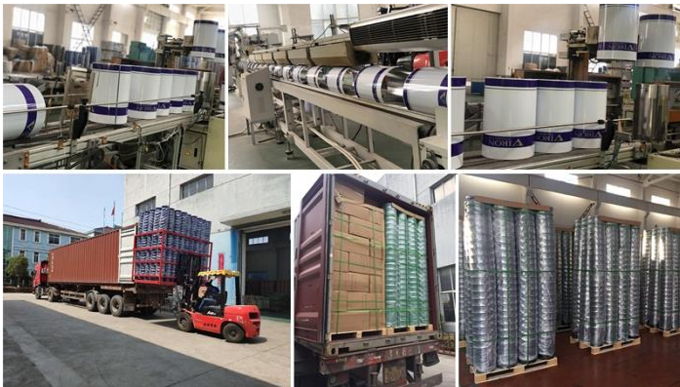

What are the production steps of Metal Pails
1. Raw material preparation
Steel selection
Use high-quality thin steel plates as raw materials. Cold-rolled steel plates or hot-rolled steel plates are usually used, and their thickness depends on the specifications and uses of the iron drums. Generally speaking, the thickness of the steel plates used to package chemical products or oil products is between 0.5 mm and 1.5 mm.
The quality requirements of steel include surface flatness, no scratches, no rust, no holes and other defects. At the same time, the strength and toughness of steel also need to meet the use requirements of iron drums.
Auxiliary material preparation
In addition to steel, some auxiliary materials such as sealants, coatings, gaskets for barrel covers and barrel bottoms need to be prepared. Sealant is used to ensure the sealing of the metal pails, coatings are used to prevent rust and corrosion of the iron drum, and gaskets are used to enhance the sealing of the barrel cover and barrel bottom.
2. Cutting
Calculate the cutting size
According to the design size of the iron drum, calculate the length and width of the required steel plate. Generally speaking, the barrel body of an iron barrel is rolled from a rectangular steel plate, while the barrel cover and barrel bottom are stamped from a circular steel plate.
Considering the thickness and processing allowance of the steel plate, the blanking size needs to be accurately calculated to ensure the dimensional accuracy of the iron barrel.
Cutting steel plate
Use equipment such as shearing machines or laser cutting machines to cut the steel plate according to the calculated size. The edge of the cut steel plate should be flat and burr-free to ensure the quality of subsequent processing.
3. Rolling barrel body
Preparation of plate rolling machine
Adjust the roller spacing and pressure of the plate rolling machine to adapt it to the thickness and width of the processed steel plate. At the same time, check the lubrication system and electrical system of the plate rolling machine to ensure the normal operation of the equipment.
Rolling barrel body
Put the cut steel plate into the plate rolling machine, and gradually roll the steel plate into a cylindrical barrel body through the rotation and pressure of the rollers. During the rolling process, pay attention to controlling the rolling speed and pressure to ensure the roundness and diameter accuracy of the barrel body.
After rolling, the joints of the barrel body are welded, generally by electric welding or gas welding, to ensure that the welds are firm and leak-free.
4. Stamping barrel cover and barrel bottom
Mold design and manufacturing
Design and manufacture the stamping dies for barrel cover and barrel bottom according to the specifications and design requirements of the iron barrel. The precision and quality of the mold directly affect the dimensional accuracy and appearance quality of the barrel cover and barrel bottom.
Stamping processing
Put the round steel plate into the stamping die, and through the action of the press, stamp the steel plate into the shape of the barrel cover and barrel bottom. During the stamping process, pay attention to controlling the stamping speed and pressure to ensure the dimensional accuracy and surface quality of the barrel cover and barrel bottom.
5. Welding
Preparation of welding equipment
Select appropriate welding equipment, such as electric welder, argon arc welder, etc. According to the material and thickness of the steel, adjust the parameters of the welding equipment, such as current, voltage, welding speed, etc.
Welding barrel body, barrel cover, barrel bottom
Assemble the barrel body, barrel cover and barrel bottom, and then connect them together by welding. During the welding process, attention should be paid to controlling the welding temperature and time to ensure that the weld is firm and leak-free. At the same time, the weld should be ground and polished to make its surface smooth and burr-free.